


Demo of Educational Activities Below
Create Your Budget & Automate
60 Minutes
The primary reason to create a budget is to build savings. That way you have money to spend on the things you want now, but also ensure that you have enough set aside to reach your long-term goals. In this topic, you will take the appropriate steps to create a workable budget and automate your financial accounting to make regular review and adjustment easy.
Overview
Wouldn’t it be nice to have money for the things you want now, while still making sure you have enough for later? That’s the goal of creating a budget and savings plan. Saving money is the cornerstone of a financially secure lifestyle, and building a clear budget may help you save more.
Did you know that about 70% of lottery winners waste all of their earnings within just a few years? And the majority of people – not just lottery winners –
are experiencing financial problems. Many of those people could have avoided financial problems if they simply had a budget in place and followed basic guidelines.
At the fundamental level, a budget is a plan for how to handle your money. Income, expenses, and savings are the essential elements of a budget. Let’s walk through the process of creating a budget together.
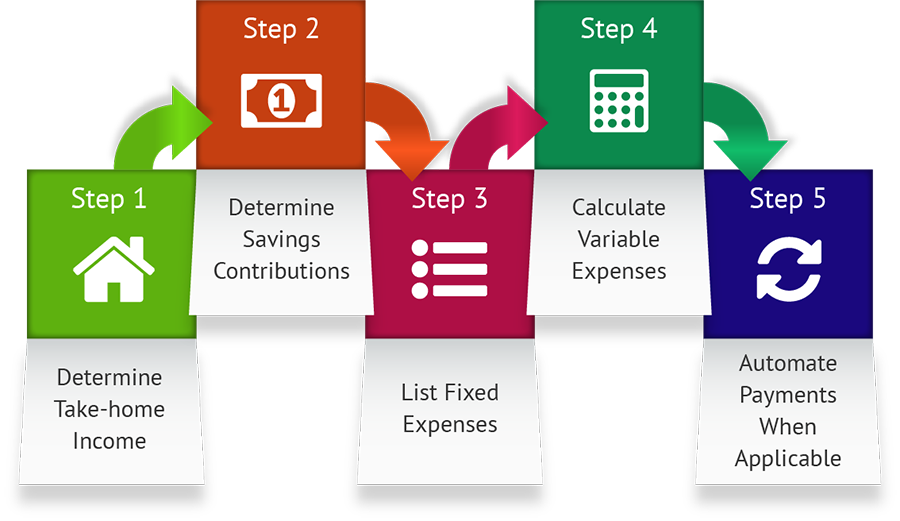
Budgeting Steps
Your first step in creating a budget is to enter your take-home income. If you receive a paycheck, use the net pay – that is, the amount you receive after all the taxes and other fees are deducted. If you receive tips or any other compensation from additional sources, be sure to add that into your income as well.
Your next step is to plan out your savings. Remember that the key goal of creating a budget is to save money. It’s important to build a budget where you put aside at least 10% of your money for long-term savings. This money should be set aside before you purchase any wants – items you don’t absolutely need for survival – or pay for items that generate additional income.
Once you complete the income and savings sections of your budget, next move on to listing your fixed expenses. Fixed expenses are the bills toward which you pay the same amount each month like rent, car payment, and insurance. Next, account for the fixed expenses you pay annually: car registration, gym membership dues, or anything else you pay every year. Enter these expenses into your monthly budget by taking the annual payment and dividing it by 12. For example, if your gym membership costs $240 a year, you should be saving $20 a month toward that bill.
The next step is to calculate your variable expenses. Some variable expenses are obvious. Utilities are a prime example: the more water you use, the higher your water bill will be. The amount varies from month to month.
However, some expenses are harder to pin down. Most of us have cash that vanishes each month into unknown voids, like stops for coffee, movies, events, or extra groceries. These are small, possibly infrequent purchases that may not register in your memory when you sit down to do your budget review.

For the next month, set a goal to get a handle on your variable expenses. Identify some or all of the “voids” into which your funds are “disappearing.”
There are several ways to track spending: save receipts, carry a small notebook, or tap into the variety of available cell phone apps and online money management tools. Another easy way to track day-to-day spending is by using only your credit or debit card to perform transactions. This way, all transactions show up on your monthly banking statement. If you are required to use cash at some point during the month, set yourself a calendar reminder to include X amount in cash purchase for Item Y when you do your budget check. You can manually add it to your budget tracking at that time.
It’s important to get into the habit of budgeting before buying. This financial philosophy suggests that you should always budget and include all the costs associated with an item before you make a purchase decision. Consider what you can afford to spend on “wants” after you put money aside in savings and your needs are taken care of. Budgeting before you make a purchase helps you set clear spending limits to mitigate the possibility of becoming emotionally involved in purchase decisions. Emotional attachments often lead people to spend well beyond their budgets. Additionally, if you require yourself to set aside money each pay period in order to purchase the item you want, you give yourself time to consider the purchase. Is it still important to you a month or two later, after you have accumulated the amount you need for the purchase?
Each of us has a limited amount of money available to spend. Being able to manage our spending is critical to achieving financial success. More importantly, when you spend wisely you have more money available to save, and also to invest if you so choose.
Budget Step 1
Enter your income – Total net (take-home) pay, tips, and any other compensation.
Budget Step 2
Plan your savings – Set aside at least 10% of your income before you purchase any “wants.”
Budget Step 3
List fixed expenses – Rent, car payment, insurance. Account for annual fixed expenses (gym memberships, auto registration, etc.) by dividing the annual payment by 12.
Budget Step 4
Calculate variable expenses – Coffee, movies, special events. Track variable expenses for a month and adjust accordingly.
Budget Step 5
Set up your budget to automate and organize your finances online. This step will ensure that you can accurately monitor your budget and make adjustments.

Setting Up Automated Accounts
1) Open Checking & Savings Accounts
If you do not already have checking and savings accounts open, shop around for the best financial institution to suit your needs. Banks and credit unions offer similar services such as checking and savings accounts, mortgages, and auto loans. However, they differ in that a bank is a company, and like most companies their primary aim is to maximize shareholder profits. A credit union, on the other hand, is a cooperative institution in which each member holds a share. There are pros and cons to choosing each type of financial institution, so you should investigate the differences before you decide which is best for you.
Further, banking products can have different benefits and terms from bank to bank and credit union to credit union. Be sure you understand exactly what your accounts offer and what they will cost you. Free checking, online banking, and savings account interest rates are common differentiators among banks and credit unions.
Many banks and credit unions offer online and automatic transaction services for paying bills, saving, and investing. These services are important to have in order to automate your budgeting system.

2) Set Up Direct Deposit
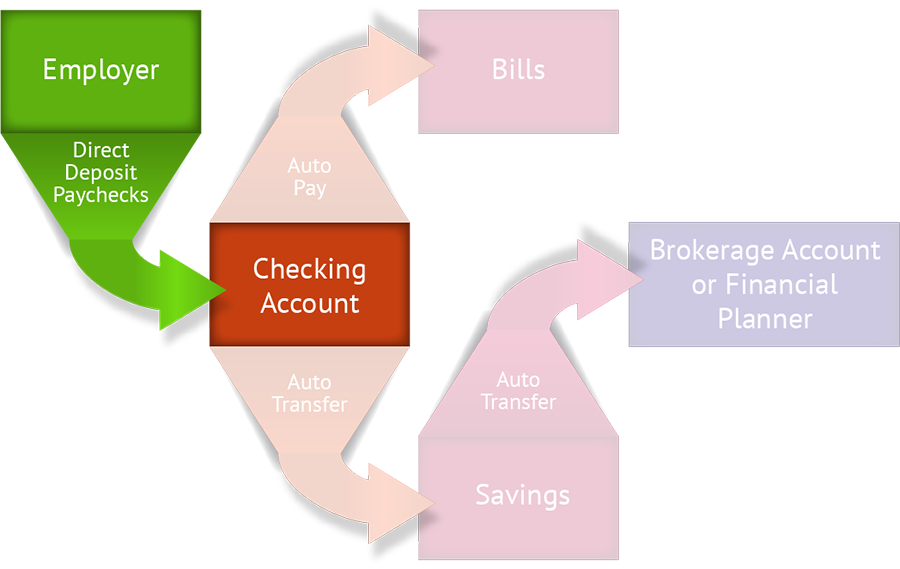
Have your employer directly deposit your paycheck into your account every pay period, if they offer that option. Direct deposit is safer than getting a paper check. You don’t have to worry about losing your check, spilling coffee on it, or the dog eating it. You also don’t have to worry about a mailed check taking a day or two longer to arrive due to a recent holiday when mail services are shut down.
Direct deposit also saves you time and money. You don’t have to pay anyone to cash your check, or waste gas money and time driving around to get it cashed.
If your employer doesn’t offer direct deposit, don’t worry; your automation plan isn’t automatically crushed. While you will still have to deposit your checks manually and face the associated risks, the rest of your automation plan can still be accomplished.
3) Automatically Pay Bills
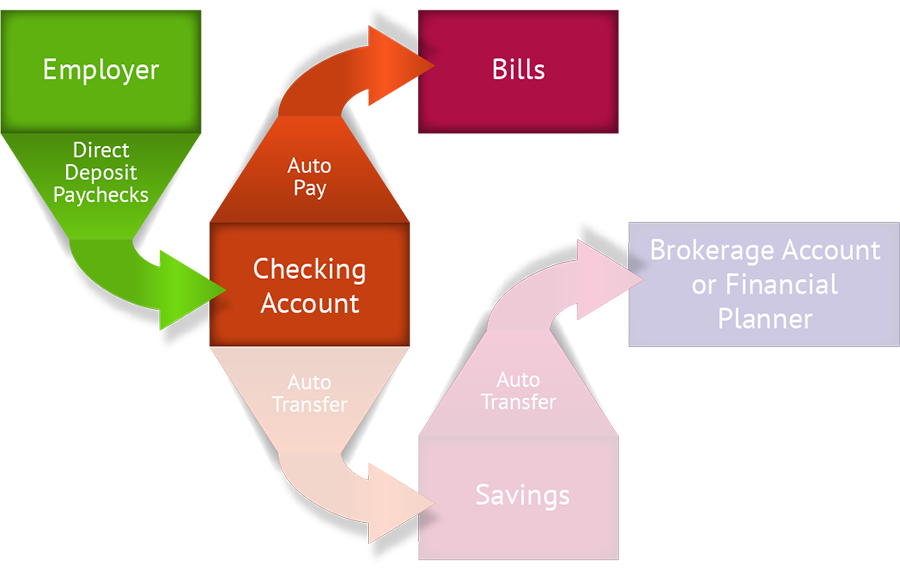
Set up your online banking to automatically pay all your bills each month. Automating your bill payments will save you time. It also saves you money, because if you accidentally pay your bills late, you also will be forced to pay a late fee on each late payment. Late fees can be as high as $40 or more, and really add up quickly. Can you really afford to waste money on late fees?
When you set up automatic bill pay properly, it also protects your credit by ensuring that all your accounts are paid on time every month. Even one late payment will hurt your credit score and, if you have several, your credit can be severely damaged.
4) Automate Savings / Investments
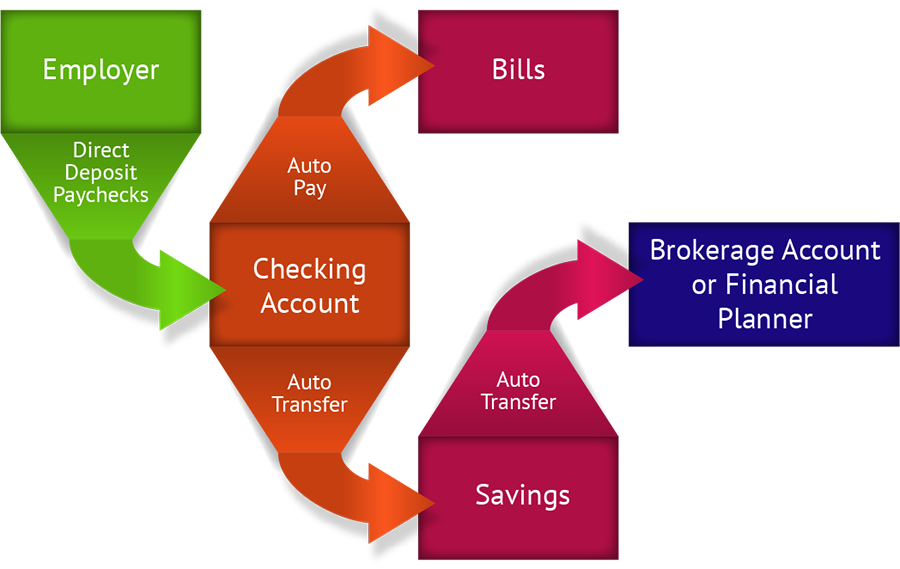
You also can set up your bank accounts to “pay yourself” first. Have your budgeted amount of savings or investment contributions automatically sent to the appropriate savings or investment accounts through automatic transfer. Some banks even waive account fees when you make an automatic transfer of at least a certain amount to your savings account each month. Be sure to find out whether your financial institution offers such a benefit.
5) What’s Left Over?
The remaining amount of money you have, after all your bills are paid and your savings contributions are made, is what you can use for “want” purchases, or to cover large spikes in variable expenses that may occur occasionally.
Using Third-party Financial Tracking Services
Third-party, online money management services allow you to connect all your online billing and banking accounts into a single dashboard; bringing all your financial accounts into one spot where you can view and track them. A popular third-party service called Mint allows you to do just that.
However, keep in mind that third-party online money management services pose two key risks:
1) Advertisements
If the service is “free,” then they probably are selling advertising that is targeted to you on the website. If you decide to use such a third-party service, keep in mind that not everything that appears on your dashboard may be the correct financial product for you.
Offers for obtaining your credit score, 0% interest credit cards, or high-interest savings funds are common ways in which advertisers attempt to reach you through the “free” service you are using. There may be nothing wrong with these services; they may be the perfect match for your needs. But on the other hand, they may not be.
Just keep in mind that “free” services are most commonly free because advertisers are paying the service provider to allow them to advertise to you.

2) Connecting Multiple Financial Accounts to a Single Location
When you link your online banking, car loan account, credit card account, utility company account, etc. to a single dashboard, there is a risk that these accounts may become compromised. That risk is especially high if you use a similar or identical user name and password for your financial accounts.
While it is unlikely that too much damage can be done directly from the dashboard, centralizing your accounts reveals critical information about those accounts. If your main dashboard account is compromised, the attacker can then see all the accounts you have linked to the dashboard. And say you used the same username – maybe even the same password – for each individual online account as you did for your central dashboard account.
If the attacker knows your credentials for the central dashboard and the online financial accounts you have linked to it, how many of those linked accounts could the attacker access with the same credentials you used on the central dashboard? Obviously, disciplined online security practices are important to mitigating your risk. Vary your user names and passwords. There are online random password generators you can use to come up with passwords that are hard to hack, and also secure password management systems you can use to organize and recall your passwords.

Conclusion
A budget comprises three essential elements: income, expenses, and savings. The primary objective of creating a working budget is to build up your savings, which in turn gets you closer to your long-range financial goals. This topic has laid out the steps for developing a budget and automating your accounts to help you stay within your budget parameters. Setting up, monitoring, and adjusting your budget over time forms an essential process toward securing your financial future.
Activity: Completing Your Budget
This activity involves completing your initial budget plan. You are provided with a link to an Excel spreadsheet that lays out each component of your budget including income, savings, fixed and variable expenses. You can use this spreadsheet tool to create your initial budget, and return to review and evaluate it over time.